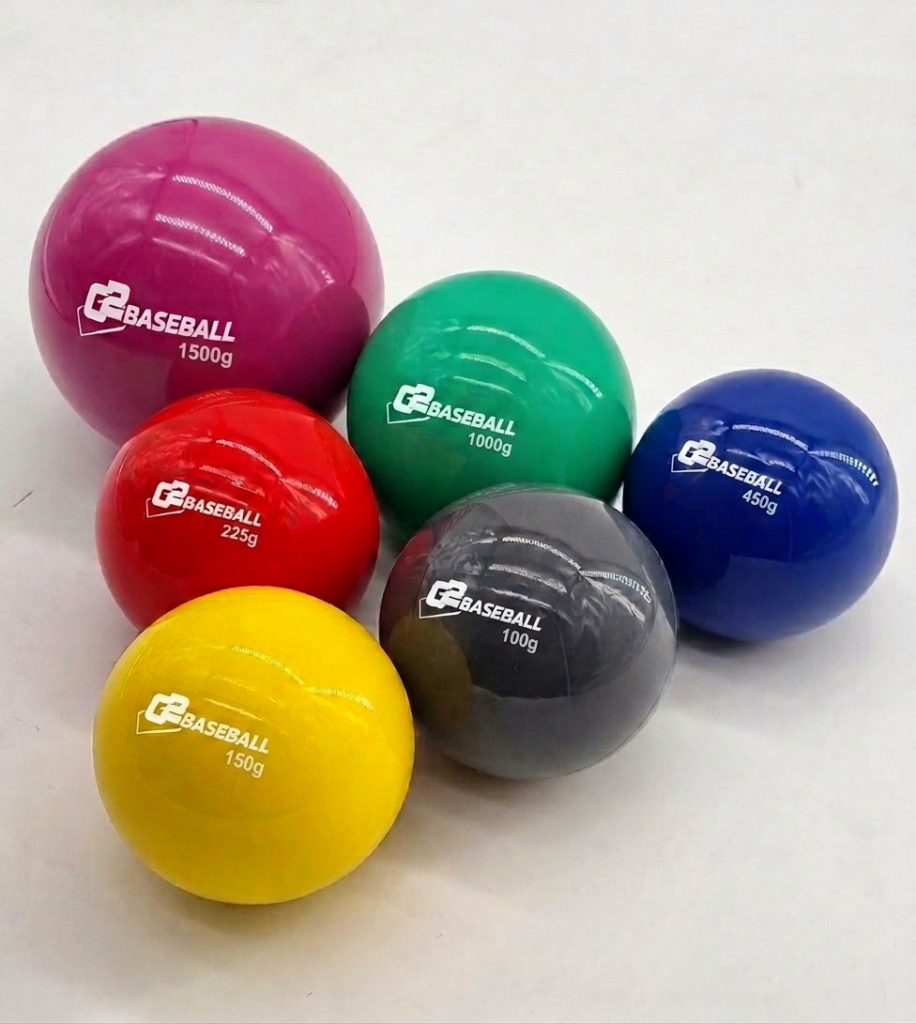
Do you find the concept of training with plyoballs interesting and have perhaps even bought a C2 Plyo Ball Set, but don’t quite know what to do with it?
No problem, I’ll try to explain it to you as simply as possible so that you can get started quickly and make progress! If you want to know more about Plyocare Balls in general, read Plyo Balls and their function.
The most important exercises
The exercises are structured in such a way that they
1. start at the end of the delivery and
2. allow more and more degrees of freedom from exercise to exercise.
As a first step, you can perform a general series of drills. Later, when you are more experienced, you can also customize the exercise selection.
Here is a brief introduction to the general series:
Reverse Throws
Youth: 10x green ball
Adult (ca 14): 10x green ball, 10x black ball
Reverse throws strengthen the posterior muscle chain of the upper body. When the ball is released, the hips are parallel to the wall and the shoulder girdle is normal to the wall. This prepares the body for the “Hip to Shoulder Separation”.
Pivot Pickoffs
Youth: 10x green ball
Adults (approx. from 14): 10x green ball, 10x pink ball
One of the most complex but also most important plyoball exercises. This exercise is very much focused on arm action and the correct timing of upper body rotation, shoulder rotation, arm extension and forearm pronation. The most important points are:
- You start with the “wrong” side to the destination
- The palm of the hand points towards the ear when lunging
- The upper body pulls the arm and hand
- The hand remains inside the elbow and should only stretch and pronate relatively late.
Rollins
Youth: 10x blue ball
Adults (approx. from 14): 10x green ball, 10x blue ball
With rollins, a linear component is added to the arm action. The step sequence is the same as for normal throwing. The big difference is that the back foot does not turn, but points continuously towards the target. This means that the hips are always open and you can feel more strongly how the armaction can help to keep the upper body closed against the open hips.
- The back foot does not turn, but points towards the target
- The upper body remains closed for as long as possible with the support of the arm action
- Ensure that the head is above or behind the belly button when the front foot first makes contact with the floor
- The front leg should not give way after landing
Foot up Rocker Throws
1x blue ball, 1x red ball, 1x yellow ball, 1x gray ball
(1-2 sentences)
Foot up rockers allow one step more freedom. In the starting position, the legs are in the same position as with Footplant during a throw. To initiate the throw, the player first pushes the hips forwards and then backwards. As he shifts his weight and hips backwards, he also lifts his front foot a few centimeters off the ground before throwing the ball. In the rocker throw, the player must/can use almost the entire chain to transfer energy to the ball. The main focus in this drill is on sequencing and the lead leg block.
- Hips initiate the movement, not the upper body
- When the front foot touches down, keep the upper body closed, head above or slightly behind the navel
- Front foot blocked after it touches the ground again
Walking Windups
1x blue ball, 1x red ball, 1x yellow ball, 1x gray ball
(1-2 sentences)
The walking windups are the final step and are closest to the actual pitching delivery. The player takes a few steps into the throw. He also lifts his knee as he would for a pitch. The exercise improves the tempo of the delivery and helps to learn to sequence the movement at a higher tempo.
- Move swiftly into the delivery
- The stride should pass straight forward after the leg lift at the latest
Incorporating Plyo Balls into training
After an extensive general and arm-specific warm-up (e.g. J-Bands, Shoulder Tube, Wrist Weight drills) and before throwing is the best time for the drills in training.
The entire series can be performed up to 3 times a week (always at least one day apart) at approx. 70% intensity. After a familiarization period of 3-4 weeks, 1-2 of these units can also be performed at approx. 90%.
On the other days, the recovery version of the exercises can be performed. These are only reverse throws and pivot pickoffs with 50-60% intensity.
Arm Recovery/Care should be performed at the end of the workout. You can find example routines for this here:
Have fun and be successful!
You can find the high-level overview of throwing, hitting, and the various areas of application in our Guide to Baseball Plyo Balls.


